Our mornings used to be a loop of me repeating the same five instructions while everyone moved in slow motion. “Shoes on. Teeth. Backpack. SHOES.” By 8am I was exhausted and the day had barely started. If your house runs on reminders, nagging, and last-minute shoe hunts, this guide is for you.
A daily routine chart for kids moves the instructions off your voice and onto the wall. Instead of you being the reminder, the chart is. Kids check off each step themselves, which gives them ownership and gives you your mornings back. I’ll walk you through building a morning and evening chart that actually sticks, introducing it without a battle, and fixing it when your child resists. There’s also a free printable chart at the end you can download and use today. The whole project takes about an hour, and most families notice calmer mornings within the first week.
A routine chart works when it is short, visual, hung where the routine happens, and introduced as a team project. Start with one routine, let your child check off steps, and revise after a week.
In this post:
1. Time and difficulty
2. What you need
3. At a glance
4. The 9 steps
5. Common mistakes
6. FAQ
7. Quick reference card
8. Free printable download
🧰 What You Need
📋 At a Glance: The 9 Steps
- Choose the two routines that cause the most friction
- Write the steps in the order they actually happen
- Cut the list down to your child’s age
- Pair every step with a picture
- Hang the chart where the routine happens
- Walk through the chart together on day one
- Hand your child the marker
- Praise the checking more than the finishing
- Revise the chart after one week
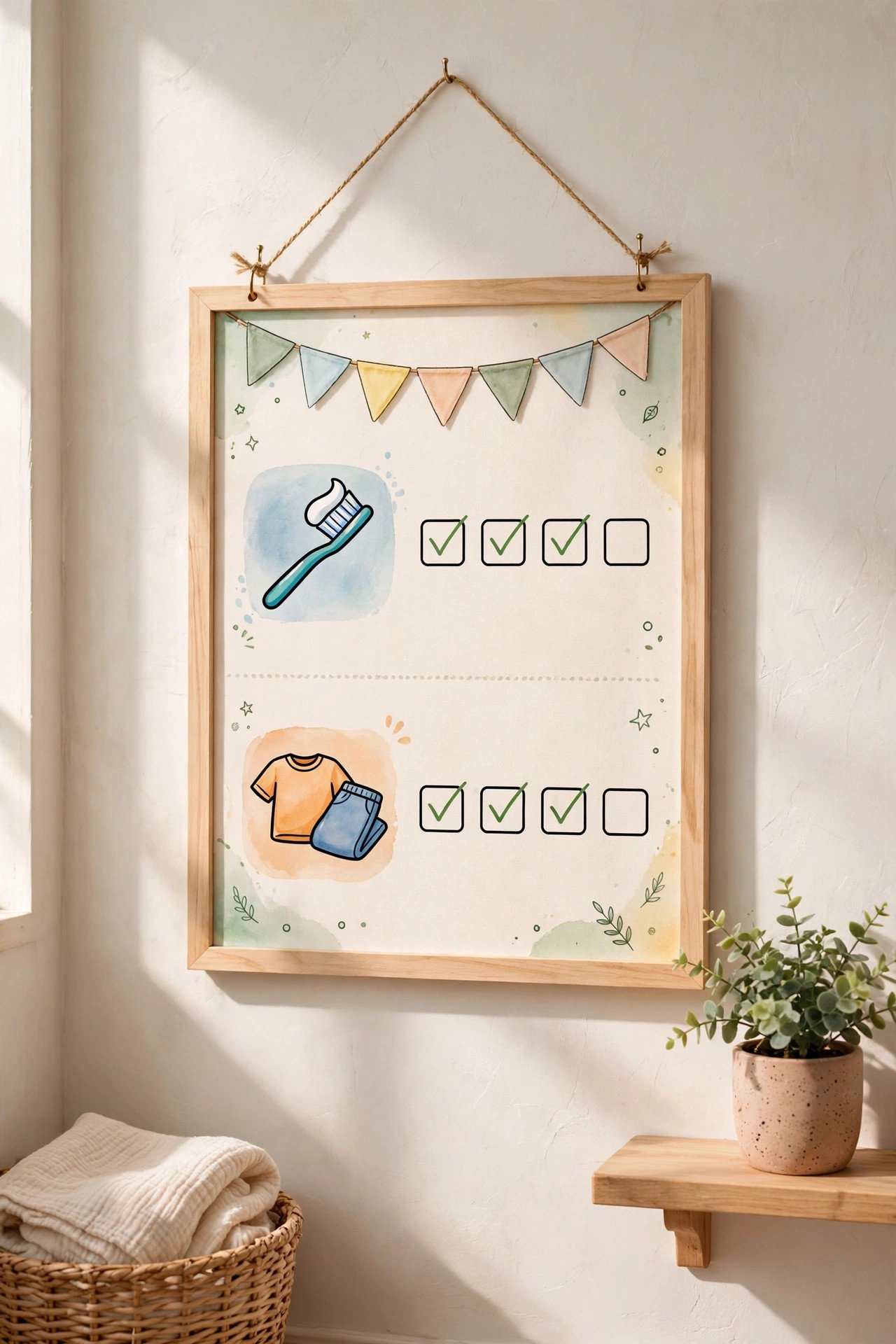
Step 1: Choose the two routines that cause the most friction
Do not chart the whole day. Pick the two routines where you currently do the most reminding. For most families that is the morning rush and bedtime. These are the moments where a chart pays for itself fastest, because right now you are spending your voice on them.
Write them down: “Morning” and “Bedtime.” Everything here builds those two charts. You can add an after-school routine later once these two run smoothly.
Step 2: Write the steps in the order they actually happen
Grab paper and write out your real morning, in the real order, including the tiny steps adults forget. A real morning list looks like this: wake up, go to the bathroom, brush teeth, get dressed, eat breakfast, brush hair, put on shoes, grab backpack.
Keep it in true chronological order. Do not group by category or rearrange for neatness. Your child will follow the chart top to bottom like a path, so the path must match reality. Do the same for bedtime: tidy toys, bath, pajamas, brush teeth, story, lights out.
Step 3: Cut the list down to your child’s age
Here is where most charts fail: too many steps. A 3 year old can handle 4 to 5 steps. A 5 year old manages 6 to 7. School-age kids can do 8, but no more. Cross off the nice-to-haves and keep only the must-dos.
If your morning list has 9 steps and your child is 4, combine ruthlessly. “Brush teeth and wash face” becomes one step with one picture. A short chart gets used. A long chart gets ignored by day three.
💡 Pro Tip
When in doubt, cut one more step. You can always add steps back in week two once the habit exists. Starting small is what makes it stick.
Step 4: Pair every step with a picture

For kids under 7, pictures are not decoration, they are the chart. A child who cannot read “brush teeth” can absolutely follow a drawing of a toothbrush. Use the free printable below, which has pictures built in, or draw simple icons together with your child.
Drawing them together works even better than printing, because your child already knows what each picture means. Stick figures are perfect. This is a tool, not art class.
Step 5: Hang the chart where the routine happens
A morning chart taped inside a closet does nothing. Hang the morning chart at your child’s eye level in the bathroom or bedroom, wherever the routine actually unfolds. Hang the bedtime chart near the bed. Eye level for a 4 year old is about 3 feet, much lower than adults guess.
Use a sheet protector or laminate it so little fingers can check things off with a dry-erase marker again and again. Tape works. Magnets on the fridge work. A cheap frame from the dollar store works and looks intentional.
Step 6: Walk through the chart together on day one
Do not hang it and announce the new rules. That is how charts become wall decorations. Instead, sit with your child and walk the whole routine together the first morning, pointing at each picture as you do it. Make it a team mission, not a mandate.
Say something like: “This is our morning map. Let’s follow it together and see if we can beat yesterday’s time.” The first run should feel like a game. By day three they will lead and you will follow, which is exactly the goal.
⚠️ Heads Up
The biggest day-one mistake is correcting your child mid-routine. If they do the steps out of order, let it go the first few days. Order matters less than ownership at the start.
Step 7: Hand your child the marker
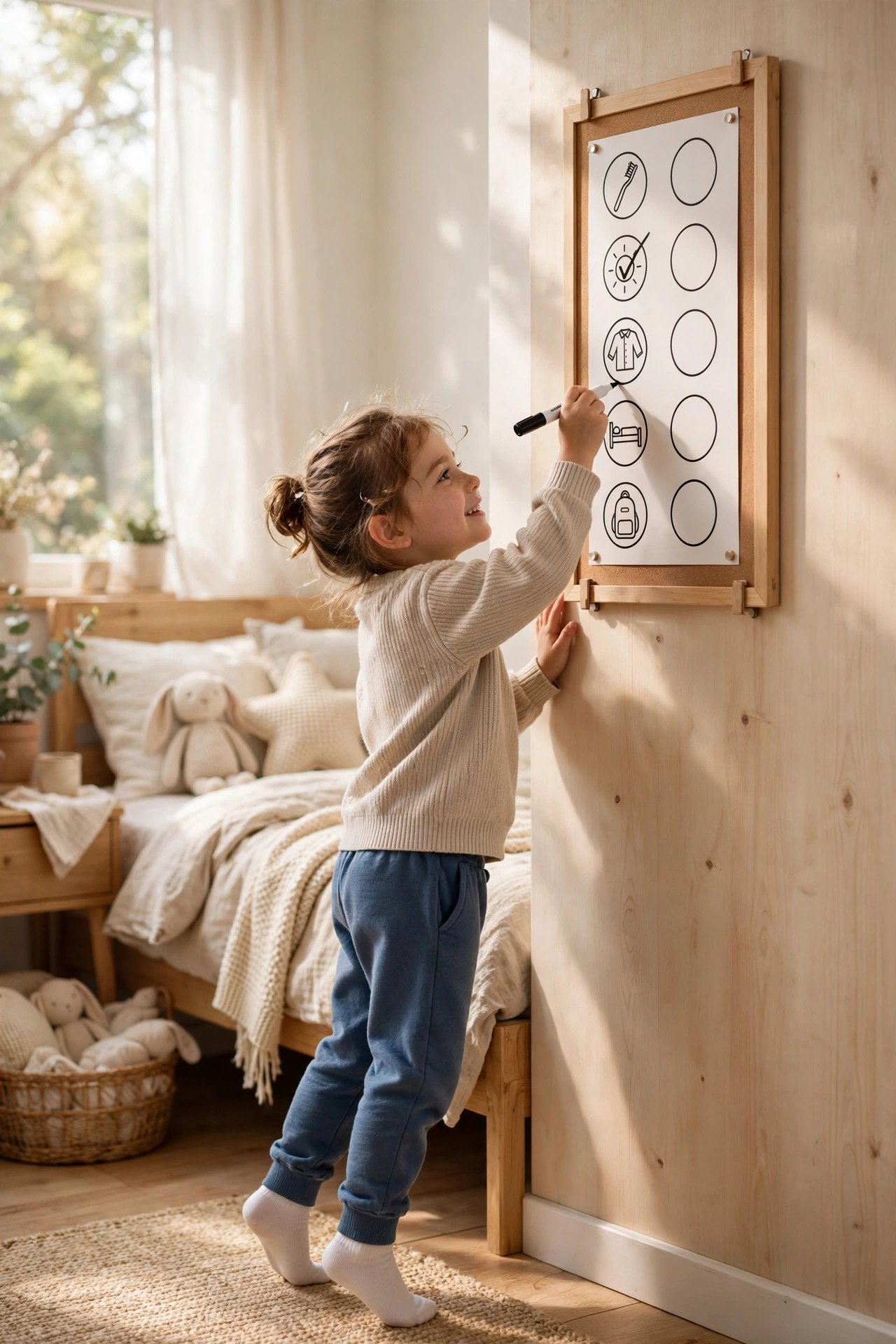
The check-off is the engine of the whole system. Give your child the dry-erase marker or the sticker sheet and let them mark each step done. That small physical act is what turns “mom’s rules” into “my routine.”
Resist the urge to check steps off for them, even when you are in a hurry. The 30 seconds it takes them to mark it is the habit forming. If mornings are truly rushed, they can check off at breakfast, but they check off, not you.
Step 8: Praise the checking more than the finishing
Notice the process out loud. “You remembered your chart without me saying anything” lands harder than “good job getting dressed.” You’re reinforcing independence, not obedience, and kids can feel the difference.
If they miss a step, point at the chart instead of giving the instruction. “What does the chart say comes next?” keeps you out of the nagging role. The chart becomes the authority, which is the entire point.
Step 9: Revise the chart after one week

After 7 days, look at what is working. Steps they skip every day might be in the wrong order or might not matter. Steps they do without thinking can stay. This is normal maintenance, not failure.
In our house the first version had “make bed” in the morning chart. It lasted four days before we all silently agreed it was aspirational fiction. We moved it to the weekend chart and mornings got smoother instantly. Revise without guilt.
🚧 4 Common Mistakes
Frequently Asked Questions
What age should I start a routine chart?
Around age 3 is the sweet spot, when kids can follow pictures in order. Under 3, keep it to 3 picture steps max. Older kids can handle more steps and even help design the chart.
What if my child ignores the chart after a few days?
This usually means too many steps, a boring introduction, or the chart hung in the wrong spot. Go back to step 3 and cut the list, reintroduce it as a game, and check the hanging height. Almost every “failed” chart is fixable.
Should I use rewards with the chart?
Small, natural rewards work best: choosing the bedtime story, 10 extra minutes of play. Avoid tying the whole chart to big prizes, which turns it into a transaction. The real reward is the pride of doing it alone.
Can I use the same chart for two kids?
Give each child their own, even if the steps are identical. Sharing a chart causes fights over the marker and confusion over whose turn it is. Print two copies, it costs almost nothing.
⚡ Quick Reference Card
You need: printed chart, crayons, tape or magnets, dry-erase marker, stickers.
1. Pick morning + bedtime 2. List steps in real order 3. Cut to age (4 to 8 steps) 4. Add pictures 5. Hang at child eye level 6. Walk through together day one 7. Child checks off 8. Praise the process 9. Revise after 7 days.
Free Printable Download
The free LumaParenting Daily Routine Chart pack includes a morning chart and a bedtime chart with pictures for every step, sized for standard home printers. Print it, let your child color the borders, slip it into a sheet protector, and hang it at their eye level today.
🖨️ Print this chart
Print this page and cut out the checklists below, or copy them onto a big sheet together with your child. Hang the finished chart at their eye level, right where the routine happens.
Morning routine
- ☐ Wake up and use the potty
- ☐ Brush teeth
- ☐ Get dressed
- ☐ Eat breakfast
- ☐ Shoes on, backpack ready
Bedtime routine
- ☐ Tidy up toys
- ☐ Bath or wash up
- ☐ Pajamas on
- ☐ Brush teeth
- ☐ Story, then lights out
Wrapping Up
You built something that will give you back your voice every single morning. Start with one routine, keep it short and visual, and let your child own the check-offs. In a week, take a breath and notice how much calmer things feel.
Save this guide for the Sunday evening reset, and grab the free printable to start tomorrow morning.
You Might Also Like
- 25 Screen-Free Activities for Kids That Actually Keep Them Busy: what to do with all that calm, independent time
- 15 Sensory Play Ideas for Toddlers Using Things You Already Have: simple sensory setups for the after-nap stretch
LumaParenting Guide
Love the free chart? Get the whole set.
The free morning chart is just the start. The full guide includes morning, after-school, and bedtime charts, a blank write-in chart, and a sticker tracker — plus the exact first-week plan for making routines stick, for ages 2–12.
21-page PDF · Instant download · Prints on US Letter & A4 · $9.99
Get the Guide — $9.99
3 thoughts on “Printable Daily Routine Chart for Kids (Free Download)”